Lexron 60A PWM Solar Charge Controller (12/24/48V)
Lexron 60A PWM charge controller (LXR-PWM-60A) for 12/24/48V batteries: input under 100V, overload and short-circuit protection. Aden Solar installs it.
 LEXRON dealer
- Model
- LXR-PWM-60A
- Charge current
- 60 A
- System voltage
- 12/24/48 V
- Charging technology
- PWM
- Panel voltage
- Input support below 100 V
- Protections (range)
- Overload, short circuit, low voltage
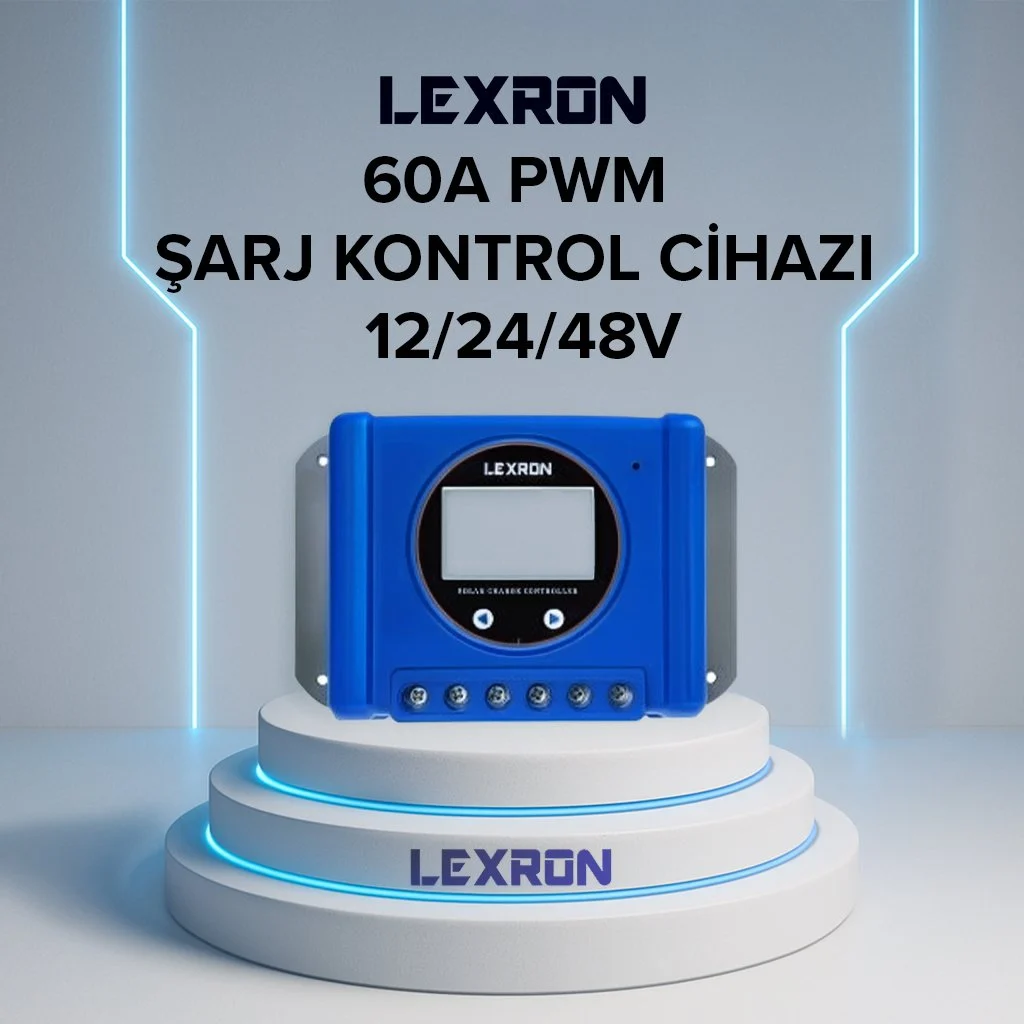
The Lexron 60A PWM Solar Charge Controller (12/24/48V) (LXR-PWM-60A) is an economical solar charge regulator that safely transfers panel energy into the battery. It delivers 60 A of charging current on 12/24/48 V battery systems and protects the battery from overcharge and deep discharge in caravans, cabins, camping and small off-grid systems. Lexron is the brand of ACS Enerji, based in İzmir, Türkiye.
Key features
- PWM (pulse width modulation) charging: a simple, economical and reliable way to move panel energy into the battery.
- Panel input below 100 V and 12/24/48 V battery support: the most powerful model in the range, usable on 48 V systems too.
- Fully compatible with 12 V, 24 V and 48 V battery systems.
- The manufacturer lists overload, short-circuit and low-voltage protection for the range.
Technical summary
- Model: LXR-PWM-60A
- Charge current: 60 A
- System voltage: 12/24/48 V
- Panel voltage: Input support below 100 V
Where it is used
- Caravans, boats and camping setups
- Cabins and small off-grid homes
- Garden, barn and greenhouse lighting
- Security cameras and small telecom systems
Which systems is it compatible with?
It is used with 12/24/48 V gel and lithium batteries, with the setting matched to the battery type. With PWM the panel’s operating voltage should be close to the battery voltage; for a 12 V battery, 36-cell panels (around 18 V) give the best results. Keep the panel input below 100 V.
Installation with Aden Solar
Aden Solar selects the charge controller to match your panel power, panel voltage and battery type. We deliver turnkey off-grid installation: free site survey, panel and battery selection, mounting, wiring and commissioning. We are your contact for warranty and technical support.
Frequently asked questions
What is the difference between MPPT and PWM?
A PWM controller pulls the panel voltage down to battery voltage and the difference is lost as heat; it is economical and enough for small systems. An MPPT controller converts surplus voltage into current, gathers more energy and is preferred with higher-voltage residential panels.
How many watts of panels can a 60A PWM controller take?
Roughly the charge current times the battery voltage: about 720 W on 12 V batteries, about 1440 W on 24 V batteries, about 2880 W on 48 V batteries. With PWM, matching panel voltage to battery voltage matters as much as the wattage.
Which panels suit a PWM controller?
PWM controllers work best with panels whose operating voltage is close to the battery voltage. For a 12 V battery, 36-cell panels fit; with 60, 72 or 144-cell higher-voltage panels an MPPT controller is more efficient.
What does a charge controller do?
It sits between the panels and the battery and protects the battery from overcharge and deep discharge. Without one, a panel wired straight to a battery shortens its life quickly.